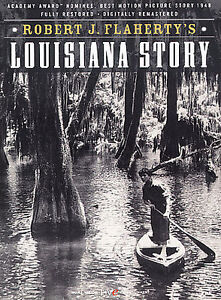
Contemporaneous reviews of the film support the claim that the film’s source of financing does not detract from its success as a work of art. Bosley Crowther of The New York Times asserts that the film “is not a submissive nod” to technology; yet, “it is recognition that the machine can be a useful friend of man, no more rapacious, in some way, than primitive man or nature themselves.” Crowther declares the scenes highlighting the oil drilling operation “the most powerful and truly eloquent phases” of Louisiana Story. Despite the sympathetic portrayal of the oil drillers, however, Crowther doubts money supplied by Standard Oil encouraged Flaherty’s perspective. Instead, Crowther asserts, “the ring of sincerity is clear in Flaherty’s film.”
Monday, March 28, 2022
Louisiana Story and Separation Between Humans and the Natural World: Reviewers' Take
Contemporaneous reviews of the film support the claim that the film’s source of financing does not detract from its success as a work of art. Bosley Crowther of The New York Times asserts that the film “is not a submissive nod” to technology; yet, “it is recognition that the machine can be a useful friend of man, no more rapacious, in some way, than primitive man or nature themselves.” Crowther declares the scenes highlighting the oil drilling operation “the most powerful and truly eloquent phases” of Louisiana Story. Despite the sympathetic portrayal of the oil drillers, however, Crowther doubts money supplied by Standard Oil encouraged Flaherty’s perspective. Instead, Crowther asserts, “the ring of sincerity is clear in Flaherty’s film.”
Monday, March 21, 2022
Louisiana Story and Separation Between Humans and the Natural World: The Standard Oil Connection
The support for oil drilling and its benefits illustrated in Louisiana Story should come as no surprise because the Standard Oil Company financed the film. In his biography of Robert Flaherty, The Innocent Eye, Arthur Calder-Marshall asserts that Standard Oil began negotiating with Flaherty as early as 1944 for “a film dramatizing to the public the risk and difficulties of getting oil from beneath the earth” (211).
Monday, March 14, 2022
Approaches to Progress and Ecology in Louisiana Story and Thunder Bay
Although both films connect the oil industry with the environment, Robert Flaherty's Louisiana Story (1948) and Anthony Mann's Thunder Bay (1953) illustrate differing visions of oil drilling, visions that draw on conflicting views of both progress and ecology. Whereas Louisiana Story advocates for a progressivist vision of progress in which corporate “big guys” rather than local “innocent” Cajuns successfully reap the benefits of modernization and an economic or “fair use” approach to ecology, Thunder Bay demonstrates a populist view of progress and an organismic or “wise use” approach to ecology. Yet both films’ representations rest on fabricated American myths, which fall flat under scrutiny.
Monday, March 7, 2022
Oil Films and/or Interdependence
Filmic representations following Kerr-McGee’s success draw on a drive to minimize the conflict between the fishing and oil industries and valorize oil drilling and the opportunities it brings. Both Robert Flaherty’s Louisiana Story (1948) and Anthony Mann’s Thunder Bay (1953), for example, commend the oil industry for bringing wealth to an otherwise impoverished region, with differing levels of interdependence between local residents and oil company outsiders on display.
Monday, February 28, 2022
The Search for the “Golden Shrimp”: The Myth of Interdependence in Oil Drilling Films
According to John Ezell’s Innovations in Energy: The Story of Kerr-McGee, after the first successful oil well was drilled out of sight of land in the Gulf of Mexico in 1947 by the Kerr-McGee Company, the January 1948 issue of Oil declared, “The Kerr-McGee well definitely extends the kingdom of oil into a new province that is of incalculable extent and may help assuage the all-devouring demand for gasoline and fuel oils” (quoted in Ezell 169). A reporter from the Kermac News illustrated this valorization of the success of the oil well: “Everybody shook hands with everybody twice” (quoted in Ezell 164-5).
Completion of British Petroleum’s Deepwater Horizon oil rig in 2009 resulted in similar kudos. As the deepest oil and gas well ever drilled offshore, the Deepwater Horizon was lauded by Robert L. Long, Transocean Ltd.'s Chief Executive Officer. On Vermont Public Radio, Debbie Elliot asserted the same positive response to oil drilling in the Gulf. But according to Elliot, fishermen and oil companies built an interdependent relationship: “The local fishermen feared their way of life was in jeopardy when the first oilmen arrived in Cajun south Louisiana. But over the last half century, the two industries learned to live together. Oil and gas brought jobs and opportunity for many families.”
It is this interdependent relationship between the fishing and oil industries that has taken center stage in media discussions after the Gulf of Mexico Deepwater oil rig explosion and spill in April 2010, in spite of the 1989 Exxon Valdez disaster that seemed to demonstrate oil and wild nature don’t mix. From a contemporary perspective, the conflict between these two industries seems new, a product of the rig explosion and its aftermath. In fact, the conflict began with the first oil well in and around the Gulf in the 1910s, culminating with the Kerr-McGee’s successful well in 1947. Any conflict between the two industries, however, has been whitewashed by media representations of their relationship, building toward Elliot’s conclusion that they learned to live together because oil brought money and jobs. Oil films reflect this myth.
Monday, February 21, 2022
Quantum of Solace and Water Wars
After Bond and Camille escape by plane and parachute into Greene’s Bolivian eco-park, they find evidence for the real reason for Greene’s establishing nature preserves: “They used dynamite,” Bond exclaims. “This used to be a riverbed. Greene isn’t after the oil. He wants the water…. It’s one dam. He’s creating drought. He’ll have built others.” With control of water, Greene and Quantum, the clandestine company he fronts can charge exorbitant prices for the resource.
Monday, February 14, 2022
Quantum of Solace and Wate rRights, continued
For Clover, Quantum of Solace “comes closer to telling the Bolivian story than the critics were able to address, or notice” (8). With the devastating repercussions of privatization, the citizens of Cochabamba revolted, so that “midway through 2000, the “Bolivian Water Wars” ended with the eviction of the consortium and, shortly, the fall of the government itself” (8), paving the way for the election of Evo Moralis and his Movement for Socialism. Vandana Shiva sees the outcome of this water war as a great victory for “the people’s democratic will” and proof that “privatization is not inevitable, and that corporate takeover of vital resources can be prevented” (103).