Saturday, March 30, 2019

Chief Daddy and Nollywood Cinema


Although I have watched many African films, most of them have been from Senegal or South Africa. Unfortunately, some of these African films were actually American or European “collaborations,” with big studios usurping film industries across the continent. In 1967, for example, long-time Fox director, Robert D. Webb went to South Africa (for 20th Century Fox International) to slavishly remake Samuel Fuller’s Pickup on South Street (1953), this time titled Cape Town Affair. Webb literally transports Pickup on South Street to its new setting, crediting Samuel Fuller and Harold Medford for a script nearly recreated word for word and for characters and interior sets nearly duplicated except for two changes: a change in two characters’ names, from Mo to Sam and from Tiger to Donkey and – most importantly—a move to late 1960s Cape Town, South Africa, that becomes concretized by a portrait of the late Prime Minister Hendrik Verwoerd on the walls of a police station and an intelligence agency’s office. And ultimately what the film reinforces is Apartheid and the White Afrikaner dominated South Africa it allows.    

Nollywood films, on the other hand, stem from an indigenous Nigerian film industry. According to Wikipedia, the term Nollywood dates back to early 2000s, traced to an article in The New York Times. Due to the history of evolving meanings and contexts, there is no clear or agreed-upon definition for the term, and it has been subjected to several controversies. I have read about this burgeoning African film industry, but Chief Daddy (2018) is the first Nollywood film I’ve viewed.

Chief Daddy, written by Bode Asinyanbi and directed by Niyi Akinmolayan centers on the family of billionaire industrialist, Chief Beecroft, a flamboyant benefactor to a large extended family of relatives, household staff and assorted mistresses. Chief lives large, like there's no tomorrow, until the day he dies suddenly and the 'bullion van' stops. What's in his will and who gets all that money? What happens next will surprise you, as Chief Daddy has the last laugh from beyond the grave.

Nollywood stars like Funke Akindele, Zainab Balogun, Ini Edo, Dakore Egbuson-Akande, Kate Henshaw, Richard Mofe-Damijo, Falz, Beverly Naya, Chioma ‘Chigul’ Omeruah, Rachel Oniga, Beverly Osu, Nkem Owoh, Patience Ozokwor, and Joke Silva heighten the effect of the film’s tired story. And the production, direction, setting, costumes and soundtrack were well done. Compositions, for example, amplified the film’s central setting as a universe of the Ebony life Show “Castle,” implying the creation of a Marvel-like universe filled with Ebony life characters. What stood out for me were the amazing costumes, especially those worn at Chief Daddy’s funeral. The colors and prints made the event and venue look like a well-curated botanical garden.

As a whole, the movie does have its shortcomings. Most significantly, an underwhelming story and distinctly one-dimensional (slightly unlikable) characters. It sometimes felt like the story was an adaptation of a bad play with the movie going through a brief rough spell at the start and ending in an unsatisfying way.

Chief Daddy sticks to the familiar “Wedding Party” formula- an event (wedding, death etc.) + All Star cast + Humor = Two hours of entertainment.  Finally, if there is any offence like having too many stars, this movie is guilty of it, because there was no role occupied by someone who could not headline a movie themselves, which leaves little room for upcoming actors in minor roles. Despite its shortcomings, Chief Daddy did offer some beautiful set pieces and provided a glimpse into the high life of a Nigerian city missing from Nigerian literary works. It was good to see a little pop culture from a primarily serious culture.


Friday, March 15, 2019

Hazel's Guidebook to the XY Chromosome--Andrea Turk

Hazel's Guidebook to the XY Chromosome - IB Short Film (Andrea Turk)

Seed Promo Video

Seed |Promo Video

Central Illinois Feminist Film Festival Winners

2019 Central Illinois Feminist Film Festival Selections


Fictional Film Selections

First Place: Papitaldirected by Narges Zakeri

The story is about a scarecrow doing his duty of scaring away the birds and fireflies in a farm, then someday one little bird which is escaping from a huntsman approaches him and hides in his pocket, the scarecrow surprisingly looks at her wondering how would some little bird dare to come near him and tries to send her away, this short animation is under the impression of love from the famouse persian philosopher sohrevardi.

Second Place: Seed directed by Jo Mbulawa

Seed is an isiXhosa film that focuses on a woman named Buhle. Buhle has always been uncertain about motherhood but is surrounded by people who want nothing more than for her to have children. 
She grapples with her fate when she ends up falling pregnant, never revealing her true feelings to her husband, Thabo; a loving and kind man who is desperate to become a father. 
But when a tragic and unexpected ordeal takes place, Buhle is forced to either come clean about how she really feels about the pregnancy or continue living a life that is pleasing to her husband, church and overbearing traditionalist older sister.

Third Place: Specially Breweddirected by Jasyika Goh

Kim, a new barista intern with mild autism and a passion for brewing coffee finally lands her dream job at a cafe. But the stigma associated with her disability creates challenges and obstacles in the pursuit of her dreams.

Honorable Mention: Hazel's Guide to the XY Chromosomedirected by Andrea Turk

Hazel’s Guidebook to the XY Chromosome revolves around the adolescent life of Hazel Hartwright, a quirky young 17 year-old who believes in true love and eventually meeting her ‘Mr. Right’. However, after a few unlucky encounters she almost loses herself in the idea of a romanticized distant future. This rom-com/coming of age movie addresses the theme of love, innocence, and self-discovery, as the protagonist later takes on the role of becoming a hero to herself.

Documentary Film Selections 

First Place: Everywhere We Go directed by Arielle Davis, Elaina Guerrero , Keianna Johnson, Josie Ramirez, Angie Rodriguez

This short documentary follows two teenage girls from communities of color who are battling mental illness and how it affects them in their everyday life. The film explores racial and cultural stereotypes around mental health in Mexican and Black communities.

Second Place: ROAN directed by Thuy Trang Nguyen

The tender relationship unfolds between an elderly Vietnamese grandmother and her granddaughter, who was born and brought up in Germany. While they spend a day at grandmother’s apartment in Berlin-Reinickendorf, they begin to share small discoveries of everyday life and larger, existential questions.

Third Place: G.E.M. directed by Mike Hooves

Where does a bicycle shop fit within feminism? A look into a weekly initiative created to allow people of marginalized genders to comfortably participate in bike shop culture.

Honorable Mention: Declaration directed by Adam E. Stone

Inspired by the Universal Declaration of Human Rights (UDHR), and the art and writing of feminist painter Saribenne Evesong (1931-2009), Declarations uses art, and the art of movement, to examine empathy as a facilitator of sustainable love, peace, and justice.

Thursday, February 28, 2019

Global Urban Farming in New Farms, Big Success: With Three Rock Star Farmers (2015)


New Farms, Big Success: With Three Rock Star Farmers (2015) takes a proposal approach to sustainable farming practices, this time with emphasis on farmers in the USA and Canada. Although the general overview of the problems associated with agribusiness is brief, each of three sections introduces solutions that address some of the same issues discussed in Voices of Transition. Environmentalist Bill McKibben establishes the film’s purpose: finding viable agricultural practices that address issues surrounding climate change. According to McKibben, climate change may have horrific effects on agriculture, depleting arable soil and discouraging biodiversity. New farming practices are necessary to combat these changes and address environmental disasters associated with agribusiness.


The first sequence highlights the work of Essex farmer Kristin Kimball, author of The Dirty Life. Her farm in Essex, New York stresses the kind of mixed farming approach discussed in Voices of Transition. Kristin raises grass-fed beef, pork, and chickens that provide fertilizer for 50-60 varieties of vegetables, fruits, and grains for bread. Her farm relies on solar energy and works toward economic, environmental, and social sustainability. Draft horses pull a cultivator from the 1930s, eliminating the need for coal or gasoline. By rotating her 500 acres of crops, Kristin solves problems such as potato beetle infestations. Only organic pesticides are used. Even chicken coops are moved every day to fertilize fields for hay. As the director of a Community Supported Agriculture (CSA) cooperative, Kristin provides consumers with produce once a week instead of following what she calls “a drug dealer model” like that of agribusiness. She emits less carbon and produces better food. 


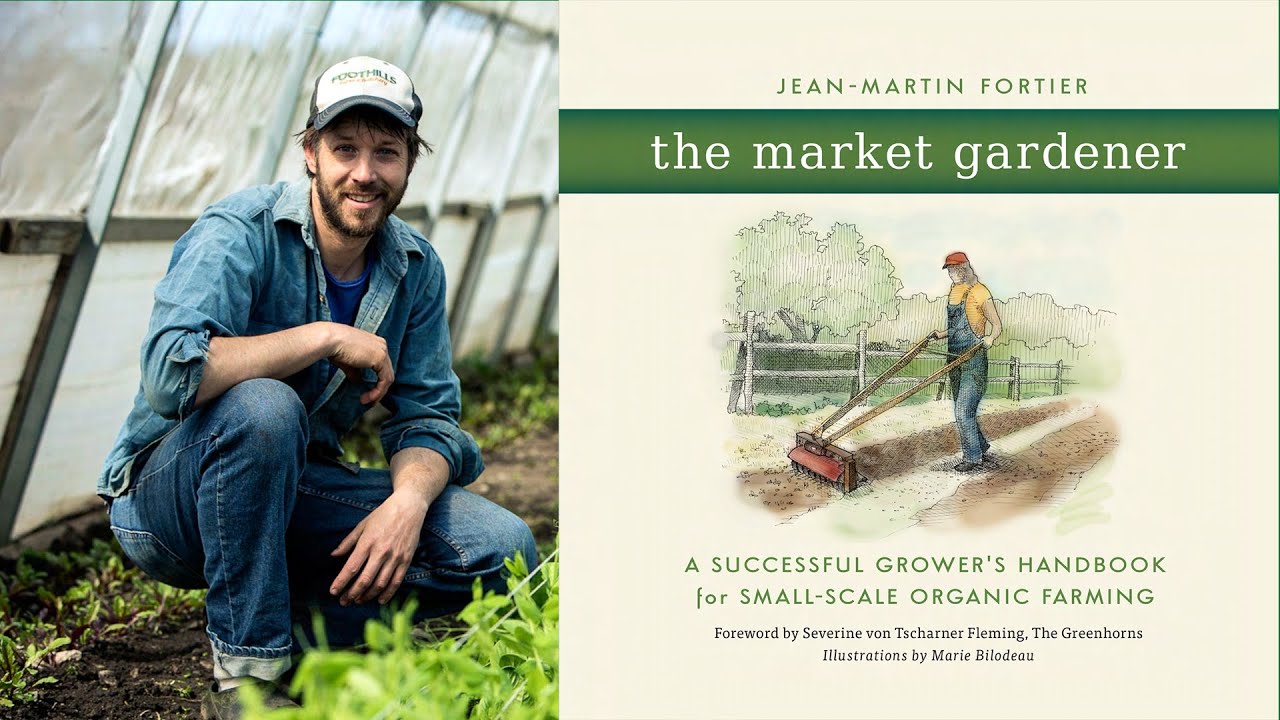
Les Jardins de la Grelinette farmer Jean-Martin Fortier, author of The Market Gardener moves Kristin’s CSA model to a small-scale organic farm right outside the city of St. Armand, Quebec, Canada. Like Kristin, Jean-Martin sells vegetables directly to consumers through CSA delivery. But he also grows and sells salad mix for local restaurants. Using only 1.5 acres of permanent raised beds, Jean-Marie grows 50 types of vegetables with help from only four full-time workers and two interns. His raised bed method requires no tractor. Soil is replenished with worms, toads, and compost, and crops are planted using a broad fork and deep rooting systems.  Planting requires a hand-pushed seeder, and insects are controlled with nets. Because the soil is covered most of the time, there is little fungus, and crop planning allows larger harvests and more closely spaced vegetables. Covering shades out weeds and keeps in moisture. After showing his rock star farming methods, Jean-Martin highlights how his approach addresses both agribusiness and climate change problems. Replacing mass production with production by the masses will allow farmers to make a living, he explains. His approach aligns with United Nations Secretary General Ban Ki Moo’s arguments that biodiversity is needed to combat environmental consequences of climate change. A lack of bio-diversity may limit goods and services for the poor. Climate change has already negatively affected pollination by bats, birds, and bees and the richness of soils. Sustainable farming practices can help combat these problems.


The last segment highlights greenhouse manager Lauren Rathmell’s Lufa Farm in Montreal, Canada. In the farm’s urban greenhouses, Lauren and her crew grow a variety of hydroponic vegetables, including eggplant, peppers, cucumbers, and tomatoes, for basket subscription holders around the city. Here the CSA contents depend on customer orders, and boxes are delivered throughout Montreal. The sequence describes and illustrates the growing process in these rooftop greenhouses. Although not certified organic, the goal is a limited carbon footprint and an adherence to as many organic rules as possible. They combat insects with insects, for example, use butterflies to pollinate and reuse water through a fully closed loop system. They harvest rainwater to reduce water consumption, as well. But because vegetables are grown hydroponically, synthetic fertilizers must be used. With 5000 subscribers, Lufa Farm relies on fifty workers to produce enough vegetables to fill and deliver box orders. This last segment shows us an alternative perspective on urban farming that stresses mechanized sustainability with less emphasis on social and environmental development. It also links to a recent debate between traditional and hydroponic organic farming. According to Wilson Ring, some farmers argue the synthetic process hydroponic farming requires does not warrant an organic label. Hydroponic urban farming may also limit sustainability.

Wednesday, February 27, 2019

Global Urban Farming in the Documentary Voices of Transition


Most urban farming documentaries showcase sustainable practices that respond to this history, offering alternatives to toxic agri-business approaches. As a proposal argument, Voices of Transition establishes and provides evidence for problems associated with agribusiness and offers three viable “transition town” solutions in three countries that address each problem. With narration from experts such as environmental activist Dr. Vandana Shiva, the documentary highlights an agricultural history that promotes a mixed farming approach, with horses and oxen pulling plows and fertilizing soil simultaneously. The change from such self-sufficiency to a reliance on tractors and toxic chemical pesticides and fertilizers in the twentieth century is condemned as the cause of ruined lifeless soil and erosion. The introduction of GMO seeds that require pesticides and fertilizers further sickened crops and the people they feed. These problems are exacerbated by a lack of governmental oversight of the farming industry and its toxic emissions, since the Clean Air and Clean Water Acts do not apply to agricultural runoff or air pollution caused by chemical fertilizers and pesticides and fuel hungry tractors, cultivators, and other farm equipment. 


Individual examples from France, the UK, and Cuba address these problems. In France, farmers fight back against industrial agricultural practices that ignore environmental damage and discourage crop diversity. These farmers seek to sever the connection between food and oil and reinvigorate a farming system that encourages monoculture crops to attract European subsidies and produces astronomical amounts of water and air pollution. Because of pesticides, bees are dying and small animal populations are decreasing. Soil microbiology researchers Claude and Lydia Bourguignon assert, “By falling into the vicious circle of chemical fertilizers, we have killed our soils, made the plants ill, and taken the first steps on a straight course towards famine.” Farmers Bernard Forey and his son Oswaldo offer another way, a better way to farm that includes moving their three-hundred-acre farm toward organic, sustainable techniques encouraging biodiversity with varied crops and collective ownership, reintroducing soil-enriching plants and trees, and marketing their own produce.


The focus on agro-forestry—the planting of trees to replenish soil and fertilize plants—in this section of the documentary connects rural farming in France with inner-city agriculture. Scientists in both France and the UK suggest that twenty percent of land should be planted in trees to heal the earth and enrich the economy. A transition movement is offered up as a solution to toxic agri-business practices. With roots in the South of England, the movement supports local resilience, fair economics, and a better life for both humans and the natural world. Urban farming in the city of Totnes, in Devon, UK, provides an apt example of the movement’s goals where community members build and cultivate raised gardens, secure alternative energy supplies, and promote public housing and health services. The goal is to encourage people to work where they live, produce energy locally, secure funding in local banks, grow and share food, and highlight public transportation instead of cars. In transition town Bristol, white East African Mike Feingold raises bees, chickens, and apple trees to produce honey, vegetables, and cider for himself and his neighbors. Urban gardener Sally Jenkins inspires others to produce food in their own gardens, and community activist Chris Loughlin shares vegetable boxes cooperatively throughout the community. These new programs build on the values represented by the Bristol Community Gardens that encouraged poor industrial workers to grow their own food in the nineteenth century. By aligning with other communities, citizens of Bristol can lead interdependently self-sufficient lives. 


The last segment of Voices of Transition reveals a city that transitioned from oil-based agribusiness to environmentally-friendly mixed farming systems: Havana, Cuba. The closed community of Havana produces seventy percent of the vegetables it needs, and many Cubans participate in urban organic and sustainable farming. In Havana, 150 workers provide food to the city’s residents by farming twenty-eight acres organically and co-operatively. These urban farmers stress biodiversity to stop pests and ensure that forty percent of the land lays fallow each year to enrich the soil and encourage a thriving biotic community. All three of these segments provide an optimistic view of farming by emphasizing viable solutions available through these “transition” approaches.  

Friday, February 15, 2019

The Machine in the Urban Garden?


Typically, films present the urban garden as a respite from the stress of the modern city, a garden in the machine like that espoused by Leo Marx. Leo Marx’s Machine in the Garden describes America as a lush, unexplored “garden” that is in a tumultuous relationship with the “machine,” or social and technological advancements throughout American history. The “machine” overwhelms the “garden” and attempts to cultivate raw resources for consumption. Marx’s thesis, therefore, is that the “machine” alters the landscape in order to make it fit current measures of productivity. Marx bases his argument on two different definitions of the pastoral, “one that is popular and sentimental, the other imaginative and complex” (5). The first, a sentimental type, is “an expression less of thought than of feeling” (5). According to Marx, “An obvious example is the current ‘flight from the city’” (5).


Urban parks and gardens may aid alcoholics, as in 28 Days (2000) and increase happiness, as in Enchanted (2007). In the Central Park musicals, Thoroughly Modern Millie (1967) and Enchanted, for example, characters enter gardens to promote traditional heterosexual relationships rather than ambitious female independence. New York City romantic comedies such as When Harry Met Sally (1989) and You’ve Got Mail (1998) show how love between heterosexual couples grows in the gardens of Central Park. Other romantic comedies, including New York City’s Green Card (1990) and Chicago’s Return to Me (2000), take a different approach to the garden, suggesting that romantic heroes Bronte (Andie MacDowell) and Grace (Minnie Driver) can only find love if they too leave the garden.


The dramas Being There (1979) and The Constant Gardener (2005) illustrate how gardens shape characters but also how gardeners Chance (Peter Sellers) and Justin (Ralph Fiennes) must leave their gardens behind to succeed. Set in Washington, D.C., Being There uses dark humor to critique the political process that leads Chance toward the Oval Office. Set in Kenya, The Constant Gardener showcases Justin’s attempts to solve a pharmaceutical mystery. In both films, gardens are a stone’s throw from mega-slums. Despite their differences, the garden and its urban setting are bifurcated in all these films, drawing on theories of the garden like that of Leo Marx.