Thursday, January 31, 2019

Wallace and Gromit and the Power of Urban Farming


Films about inner-city gardens suggest interactions between human and nonhuman nature may restore both, providing psychological benefits for humans that also encourage the nurturing that allows the natural world to thrive. But that psychological need to affiliate with nature only becomes possible if other human basic needs are fulfilled. 


When the garden turns into a source of food, it begins to serve those without access to fresh fruits and vegetables. Ideally it also transforms food deserts into urban farms that rest on principles of the sustainable development movement espoused by the Brundtland Commission. According to the Commission’s 1987 report, sustainable development is simply the “ability to make development sustainable—to ensure that it meets the needs of the present without compromising the ability of future generations to meet their own needs” (quoted in Kates, et al 8). Documentaries and fictional films exploring urban farming celebrate those farms that promote sustainable development practices. The best of these films showcase practices that align and facilitate sustainable economic, social, and environmental development. 


One of the most popular urban farming films, the stop-action animation wonder Wallace and Gromit: The Curse of the Were-Rabbit (2005), illustrates how human and nonhuman nature can work collaboratively to facilitate sustainable development in a community of urban farms. Set in an urban setting where police officers still walk a beat, The Curse of the Were Rabbit offers both laughs and suspense, with a plot addressing individual farms constructed not only to supply food but also to grow champion vegetables for an annual contest. When a giant were-rabbit begins devouring award-winning vegetables, owners and operators of the Anti-Pesto company, Wallace (Peter Sallis) and his dog Gromit set out to stop the destruction and save the farmers and their annual event. 


Although this comic plot seems more like entertainment than bearer of environmental message, the resolution to the conflict points toward the kind of sustainable development recommended by the Brundtland Commission. Ultimately Wallace and Gromit not only solve the mystery when they discover the source of the were-rabbit; they also choose a sustainable solution that protects vegetables, rabbits, and the community: a wildlife refuge on Lady Campanula Tottington’s (Helena Bonham Carter) estate that allows both urban farms and bunnies to prosper. 

Sunday, January 27, 2019

The Scent of Green Papaya and Gardens, Conclusion


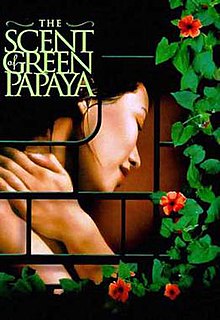
When Mui dresses in the clothes her former mistress gave her, even painting her lips with lipstick, Khuyen notices her, but the camera reveals not her entrance into modern Vietnam but her connection with the garden. Shots of her inside and out through latticed windows reveal how her beauty aligns with that of nature. Close-ups of rainwater juxtaposed with the shower in which Mui washes her hair reinforce this connection. When Khuyen enters her room, he sees the cricket and hears frogs before noting her beauty.


Although Mui does break up Khuyen’s romantic relationship, the film suggests he has chosen well. Mui writes, “In my garden, there is a papaya tree where papaya hang in bunches.” To illustrate her words, she washes and prepares a papaya, slicing it, revealing the seeds in extreme close-up, and picking out one she places on Khuyen’s plate. 


These close-ups of an open white-seeded papaya juxtapose with shots of a now-pregnant Mui further connecting human and nonhuman nature in the film. The last lines she reads during a literacy lesson reinforce this connection. Now “cherry trees are gripped in shadow” and the end is announced atop a statue of Buddha. The Scent of Green Papaya shows us what an ideal middle place might look like, if only in a fictional narrative and a visually poetic film.

Thursday, January 17, 2019

The Scent of Green Papaya and Gardens, continued

The Scent of Green Papayas and Gardens, continued


The contrast between Mui and the family continues ten years later, when Mui, now twenty, is forced to leave the 
family and serve her childhood crush, Khuyen (Hoa Hoi Vuong). The lizards climbing out of vases in these 1961 
scenes seem to suggest the civil war outside the garden gates, a point amplified by the sounds of war planes overhead. 


But Mui still watches ants in the courtyard and cares for her cricket. With the father dead and mistress in bad 
health, however, a daughter-in-law forces Mui to leave, to save money and empty the garden for a parrot farm. 
Only the mistress laments Mui’s departure, giving her gifts she would have shared with the lost daughter.


When Mui leaves, she takes the crickets and bids the garden and mistress goodbye, taking a portion of the garden 
with her. And in her new home, Mui bridges the natural world and corrupted middle class together through her 
relationship with Khuyen and the plants both inside and out, initiating a middle place where both human and 
nonhuman nature can thrive. She waters potted plants in an inner courtyard, watches toads on leaves, and 
again cooks meals outside, making Khuyen dinner while he plays Gershwin tunes on the piano. 


Here war planes are heard only in the background and are nearly shut out by the piano and birdsongs.  
Although Khuyen is dating a Westernized woman, Mui watches him and nurtures him as carefully as 
she feeds her cricket and waters frogs in the courtyard. In this house, pots are full of plants instead of 
empty adornments. And instead of taunting or ignoring her, Khuyen notices Mui’s connection with 
nature and careful attention to him, bridging nature with the contemporary world.

Wednesday, January 9, 2019

Post-Colonial Vietnam and the Garden in The Scent of Green Papaya (1993), Part I


In The Scent of Green Papaya, a courtyard garden serves as young servant Mui’s (Man San Lu and Tran Nu Yên-Khê) respite from a coming war and a 1950s and 1960s bustling city outside its walls, but it also shelters her from the traumatized family she serves, moving her to a middle place like that Adamson describes. Washington Post critic Hal Hinson explains, “In The Scent of Green Papaya, Vietnamese filmmaker Tran Anh Hung’s exquisite, inscrutable elegy for the lost country of his birth, time is not counted in minutes or hours, but in human measures—heartbeats and muffled prayers.” 


We agree but would add nature to the mix, since the inner garden serves as a character in communion with protagonist Mui. For example, when ten-year-old Mui enters the garden, vines, bonsai trees, potted plants, and papaya trees seem to greet her before an older servant Thi (Nguyen Anh Hoa) picking a papaya meets her and leads her to her sleeping quarters. After her long walk from the village, the mistress of her new household (Truong Thi Loc) suggests she sleep, but instead Mui gazes at the plants and birds in the garden, watching milk on a leaf falling from the stem left by the papaya. We see the stem and milk in close-up, turning it into a broad landscape. Lizards climbing trees, frogs in a pond, and singing crickets mesmerize Mui. She also nurtures a cricket, feeding and watering it in its homemade cage. Close-ups of an open white seeded papaya highlight Mui’s natural development. Ultimately, Mui becomes part of the garden, preparing meals for the family and eating leftovers like the ants she watches carry rice scraps to their nests.


Mui’s reverence for nature in the garden contrasts dramatically with the dysfunctional relationships the father and sons have with one another and the natural world. Mui listens to birds sing while she cleans the floor on her knees, but the father (Ngoc Trung Tran) stays in his room playing a stringed instrument, grieving a lost daughter and blaming himself for her death. Since he left with all their money and jewels before her death, he has good cause for his guilt. Without money, the mother could not afford the doctor or medicine to treat her. And when he leaves again, he returns only to die in his bed. The middle son also watches insects, but he pins them to his wall. And when he sees ants carrying crumbs on his windowsill, he pours melted wax over them. He smashes ants struggling to escape the wax. The youngest son spills water on Mui and farts at her as he leaves. Instead of admiring the work of lizards, he ties one to a stick and scares Mui with it. He even urinates in a vase in front of Mui and outside beside the papaya tree. Only the mistress treats Mui and the courtyard garden with respect, perhaps because Mui so reminds her of a daughter who died seven years ago.

Monday, December 31, 2018

Two-line Poems for New Years

Four months of sadness 

enough to move 
just one more step 

up the hill past the creek 
where they threw two suitcases 
out a car window 

planting blue and yellow 
weeds in clay 

or a story 

in these tired eyes 
still looking up 

to see the moon. 


Pacing herself 

a metronome 
sounds 
the floor 

of her bog 
of a body 

cattails tickling
an ear 

where that 
conch shell 

flows 

red whispers 

to the sea.

Milk of Sorrow and the Gardens Part III

Milk of Sorrow and Gardens, Part III


The wall and gates, however, limit this garden to only the rich white colonizers and lock out 
Fausta’s indigenous family members and their impoverished community. As if responding to 
this exploitation, Fausta’s nose bleeds when she encounters her mistress Aida. In her servant’s 
alcove, she sings to hide her fear as she cuts off potato growth. The estate garden seems to 
usurp her own inner garden in this scene. Yet, when Fausta encounters and joins forces with 
the estate gardener, Noé (Efraín Solís), she discovers a way to bridge her community’s 
constructed garden and her own inner garden with the fecundity of Aida’s oasis. An initial 
connection occurs when shots of a colorful wedding in the desolate Lima hills are juxtaposed 
with images of a shattered piano disrupting Aida’s garden. In Lima’s desolate landscape, 
ornate clothing and violet tents transform into flowers erupting out of the desert. But Aida’s 
paradise is disrupted by the broken piano thrust from a window into the foliage below. In 
both scenes, the garden and machine merge, highlighting the similarity between the two 
spaces.


But it is Fausta’s relationship with Noé that moves her to a middle place that allows both 
human and nonhuman nature to blossom. Aida and her garden highlight the war and 
exploitation Fausta and her mother attempt to escape in Lima. Fausta’s uncle’s family 
shows us an artificial garden built for the colonized. But Noé and Fausta integrate 
nonhuman nature in the wasteland outside Aida’s walls. Although Aida claims watering 
her garden “calms her,” she exploits Fausta, stealing her mermaid song and breaking 
a promise to give Fausta the pearls they collect from a broken necklace. She remains 
locked away, even throwing Fausta out of her car after a concert. Noé on the other hand, 
offers her comfort and security, not only by escorting her home (from a distance) but 
by teaching her to cultivate plants, a skill she gained first from a village vegetable garden 
before their forced move to Lima. As Noé explains, “plants tell the truth about people,” 
and the flowers she chooses tell him she needs comforting. Together they burn the piano, 
as if resisting the machine. And instead of “bleeding roses” from her nose, Fausta holds 
a gardenia in her mouth. When she asks him why he plants everything but potatoes in 
the garden, Noé explains that potatoes are cheap and flourish little.


When Fausta finally begs to have the potato removed, she and Noé gain access to that more 
verdant middle place. After stealing back the pearls she earned, Fausta faints at the estate 
gate where Noé finds her and carries her to the clinic for the removal. With the pearls in 
her possession, Fausta can transport her mother away from Lima and reunite her with the 
natural world she was forced to leave behind. In a dramatic turn, Fausta carries her mother 
across a beach and leaves her close to the ocean where she sings as the sea takes her mother 
home. Fausta has now become part of a larger biotic community, a middle place where 
thriving traditional parks, bright-colored constructed gardens, and her own potato can thrive. 
As a symbol of this middle place, Noé leaves a flower on her porch, a blooming potato plant.

Wednesday, December 26, 2018

Milk of Sorrow Part II


A doctor’s visit to treat the bloody nose broaches a second garden, a vining potato Fausta has inserted to shield her from men and the trauma her mother suffered. The uncle insists they are there only to treat her chronic bleeding and fainting episodes, and claims they are a product of her “milk of sorrow,” a horrific side effect of the terrorism into which Fausta was born. But the doctor notes only the potato, which has now inflamed Fausta’s vagina. If the potato grows, the doctor explains, roots will protrude. The uncle worries about harvesting potatoes and insists Fausta’s only ailment is the milk of sorrow. And Fausta argues the potato is not meant as a contraceptive but as a rape deterrent. Fausta is becoming a garden, but to avoid infection, the potato should be removed. Then Fausta can escape the trauma of her mother’s rape and death and consequently more effectively represent a middle place like that Adamson asserts.


Fausta’s attempt to bury her mother in her home village outside Lima reveals the third garden in the film: a traditional imperialist garden behind enormous gates walling out Lima and the arid mountains surrounding it. When her uncle gives Fausta only until his daughter’s wedding to bury her mother in her village, Fausta must find funds to transport the corpse. As New York Timescritic Jeannette Catsoulis explains, the film “explores the possibility of female empowerment in a culture suffocated by superstition and poverty.” If she fails to collect the needed money, Fausta’s mother will be buried in the backyard, in a grave her uncle transforms into a makeshift swimming pool. After investigating alternatives, including taking the body on a bus, Fausta accepts a job as a servant for a wealthy musician. When Fausta enters the estate, she leaves the noise and desolation of Lima behind her. Inside the estate’s gates is a green paradise full of trees and flowers. This literal garden aligns with a parting song Fausta sang to her mother’s corpse as they preserved it. For Fausta, her mother will be “picking flowers in heaven.” In the estate garden, Fausta can pick them on Earth.