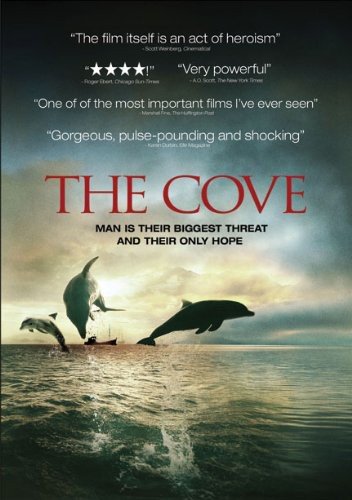
The Cove demonstrates dolphins’ connections with humans first through Ric O’Barry’s recollections of interactions with the dolphins he captured and trained for the television series, Flipper (1964-1968). According to O’Barry, he captured and trained the five female dolphins that played Flipper in the television series, translating the script into dolphin action each day. The dolphins’ skills and intellect surprised and impressed even O’Barry. They even recognized themselves in the show, when they saw themselves on O’Barry’s television. O’Barry lived in the house at the end of a dock featured in the series, so he came in contact with the dolphins almost every waking hour. When the show ended, however, the dolphins were sold to an aquarium where they entertained crowds, seemingly smiling throughout the show, “nature’s greatest deception,” according to O’Barry.
This connection with humans unfortunately leads to their harm or even death. According to O’Barry, the aquarium life is so stressful for dolphins, they must take Maalox and Tagamet every day. They travel forty miles a day in the wild. Captivity not only confines them, but also interferes with their sonar. O’Barry explains, “When they are captured and put in a concrete tank surrounded by screaming people, the noise causes stress.” The sound of the filtration system was found to kill dolphins and had to be modified. O’Barry’s commentary demonstrates both their sentience—ability both to feel pleasure and pain—and their self-awareness—ability to recognize themselves on television, arguing effectively that dolphins should be preserved because destroying them means destroying persons of equal value to humans.
The Cove also valorizes dolphin’s intelligence as a connection to humans through information provided by Dr. John Potter, who measures intelligence in dolphins. Dolphins respond to signals in American Sign Language, but they also connect with humans on an emotional level. According to Mandy-Rae Cruikshank, one of the divers in the film, a dolphin swam with her and invited her to rub its belly. Surfers recount stories of dolphins saving them from shark attacks. According to the film, then, dolphins have worth, so they deserve to live. They also deserve the freedom all persons of equal worth deserve.
The Cove has received nearly universal acclaim, earning a 2009 Academy Award for best Documentary Feature film, perhaps because it is, according to Andrew O’Hehir, “a grim tale of murdered dolphins and poisoned school kids” that spins into “an amazing, real-life spy story video.” O’Hehir asserts, for example, that the film “raises troubling questions about how badly we have befouled the 70 percent of our planet that’s covered with water, and about why we have treated the species closest to us in intelligence with such cruelty and contempt.” Justin Chang declares, “Eco-activist documentaries don’t get much more compelling than The Cove, an impassioned piece of advocacy filmmaking that follows Flipper trainer-turned-marine crusader Richard O’Barry in his efforts to end dolphin slaughter in Taiji, Japan.” According to Chang, “it’s hard not to feel that there’s something uniquely barbaric about the destruction of this exceptionally intelligent, human-friendly species. Even Noel Murray, who calls the film “muddled” suggests that “The Cove offers a lot to think about in terms of the future of fishing, and Psihoyos’ gift for fiction-feature conventions does make a seemingly unpalatable subject entertaining.”
Murray’s critique of the film, however, like other reviewers’ accolades, rests on its reliance on the point of view of dolphin advocate, Ric O’Barry, who, as Murray suggests, sides with “anyone who wants to protect dolphins, whether they want to shutter Sea World or not.” The Cove, then, is both praised and condemned because it valorizes an animal rights ethic. Animal rights ethicists like Peter Singer first argue that dolphins as a species deserve the same liberation movements as do human groups. As Singer argues, the film suggests that speciesism should be eradicated, just as racism and sexism should be abolished, primarily because animals are so much like humans.
To support his claim, Singer asserts that humans are only considered morally superior because they belong to the species Homo sapiens. Singer also suggests that using this membership to define superiority is completely arbitrary. Instead, then, we should consider sentience—the capacity of a being to experience pleasure and pain—as a plausible criterion of moral importance. If we use sentience as a criterion, we extend to other sentient creatures the same basic moral consideration, the basic principle of equality. Therefore, we ought to extend to animals the same equality of consideration that we extend to human beings. Singer, like O’Barry, also connects selected animals more closely with humans, defining them as persons, a category that includes both sentience and self-awareness over time. In The Cove, O’Barry defines dolphins as both sentient and self-aware, offering these characteristics of persons as reasons for ensuring their safety and freedom.
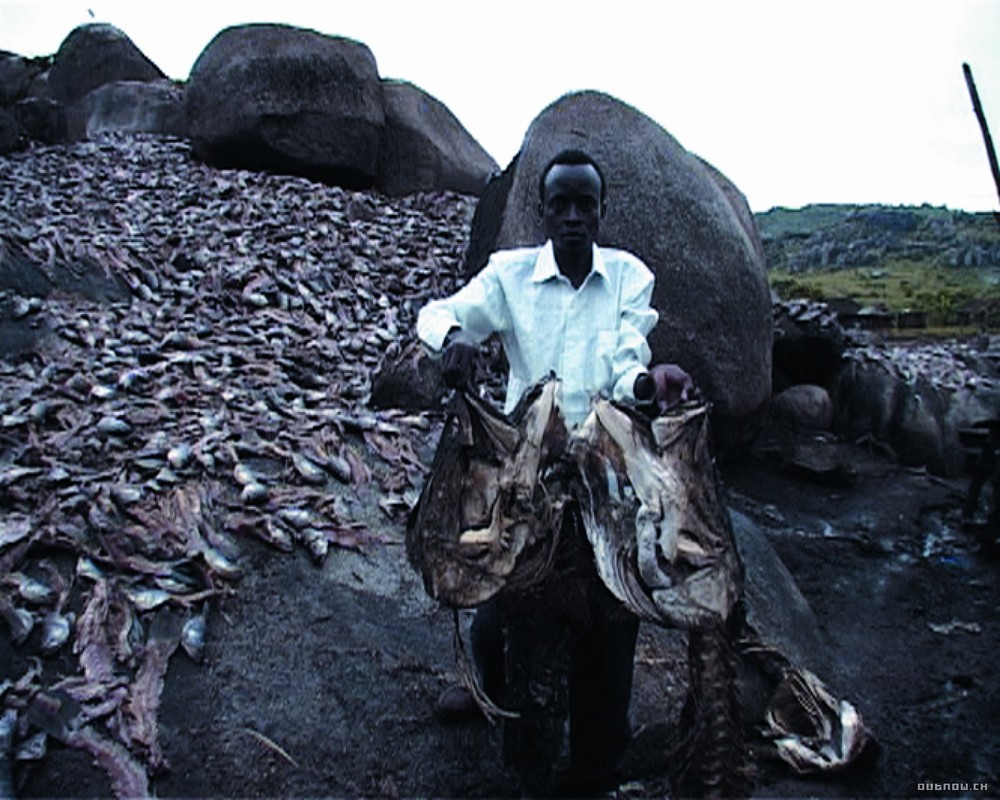
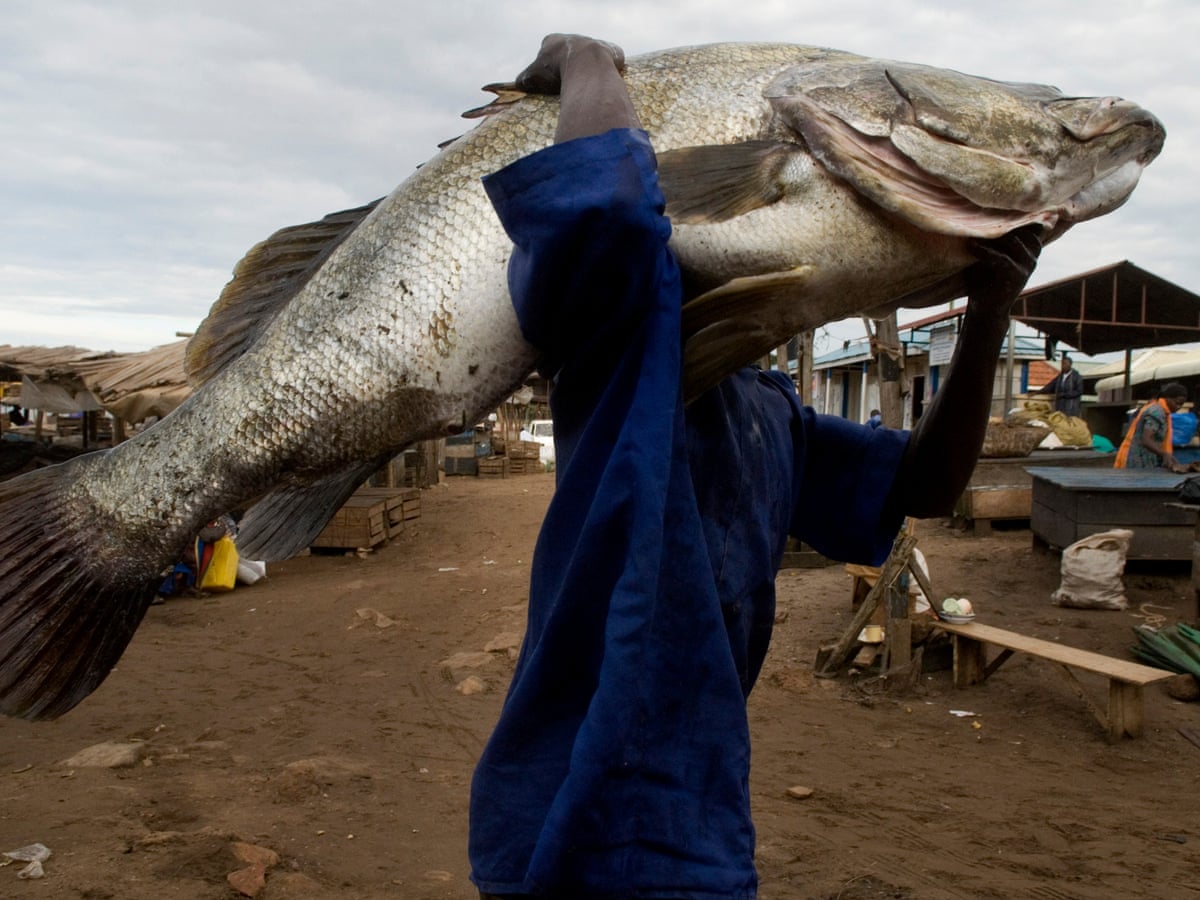
Despite the European Union’s claim that Nile Perch from Lake Victoria have not been allowed in EU market countries since 1999, the exporting continues, according to Darwin's Nightmare, leaving a Syrian factory owner free to play with a mechanical dancing fish while the UN discusses a food shortage in Tanzania on a television news program and starving children fight for food. As Noel Murray suggests, “only a movie could catch the irony and horror of an office manager proudly showing off his Billy Bass while local children beat each other senseless over handfuls of rancid rice.”
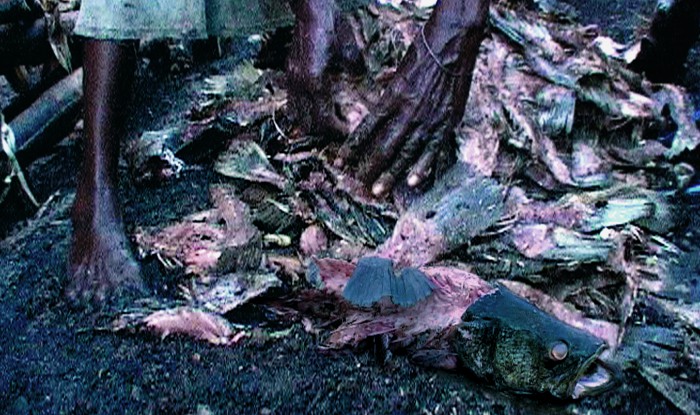
At the end of the film, Tanzanians rally and pray for food while watching a film about Jesus as a fisherman. Factory workers pack fish in boxes and onto cargo planes, leaving only bones and fish heads for the locals. Eliza is killed, leaving her friends to mourn, and a one legged-boy walks down empty railroad tracks while a man reads a BBC Focus on Africa magazine claiming there are no supplies for Tanzania. It would be a good idea for his son to be a pilot, he explains, so he can bring back supplies from Europe. Boys in the street smoke glue from empty soda bottles and sleep, and another plane takes off in a storm with thunder in the background. A Tanzanian woman watches from the ground.
Director Hubert Sauper used a minimalist unit to shoot Darwin’s Nightmare, relying only on himself, his camera, and his companion, Sandor to document the figures he followed throughout the film. Although Sauper and Sandor faced obstacles when shooting the film, including multiple arrests that required bribes to earn their freedom, Sauper found effective footage to make his point. According to Sauper, “When you look out for contrasts and contradictions, reality can become ‘bigger than life.’ So in a way it was easy to find striking images because I was filming a striking reality,” a reality that demonstrates the need for an interdependent biotic community.
Even though Sauper argues that Tanzania’s dilemma is a product of evolution, we assert that Darwin’s Nightmare shows us what happens when the biotic communities of and between nonhuman and human nature are disturbed. Here, unlike The Cove, the film argues that a single species—either the Nile perch or the European colonizer—can destroy its environment and even itself. Instead of arguing for animal liberation, the film upholds the need for interdependent community.
The consequences of such destruction are monumental and ultimately end in both lake and land turning into barren sinkholes. But the film stands only as a warning against disrupting other biospheres. It is too late for Lake Victoria and, perhaps, for Tanzania, the film suggests. Both Darwin’s Nightmare and The End of the Line, then, demonstrate that arguments against over fishing that are based in organismic ecology may or may not change behaviors. Documentaries with animal rights-driven arguments, however, may produce real change.
To document the effects of such an evolutionary nightmare, Darwin’s Nightmare opens and closes on views of the European cargo planes landing in and leaving Tanzania, all piloted by white European men who look well-fed in contrast to Tanzanians pulling an out-of-control cart full of perch in the impoverished town or fishing on Lake Victoria, the source of the Nile and birthplace of civilization. Both fishermen and the boys pulling the cart take them to the factory, explains Marcus, a police officer. The film also shows us how both fishermen and boys suffer because their source of food has become a commodity. Fishermen and their families starve. Some fishermen die on the lake, leaving wives and children to mourn them. Many children end up orphaned and living on the street, fighting over scraps of food and falling into a drug-induced sleep on sidewalks and in doorways.
Women in this colonized community are left with few choices. After their husbands die of AIDS, fishing accidents, or war, they care for their children until they starve to death, die from fumes exuded by smoking perch corpses, or sell themselves to the European cargo pilots. They may then live in brothels and bars constructed for their colonizers where they sometimes die at the hands of their so-called benefactors, as does Eliza, a beautiful young woman highlighted in the film. The lone fish factory employs only 4000 people and pays as little as possible—a dollar a day for a night guard, for example.
The film personalizes each of these struggles: It foregrounds Eliza’s attempts to figure out her life, her glowing smile, and her powerful voice singing her country’s anthem, “Tanzania.” It also focuses on Raphael, a night guard fearing for his life, since the previous guard had been murdered, Jonathan, a painter who documents the life on the streets he left behind, the group of boys fighting to survive on the street, and the cargo pilots themselves, some even regretting their part in the arms sales that contribute to so many deaths.
Director Hubert Sauper suggests that Darwin’s Nightmare stands as evidence that “The old question, which social and political structure is the best for the world seems to have been answered. Capitalism has won.” For Sauper, the changes in the communities around Lake Victoria are evolutionary and demonstrate that “the ultimate forms for future societies are ‘consumer democracies,’ which are seen as ‘civilized’ and ‘good.’ In a Darwinian sense, the ‘good system’ won. It won by either convincing its enemies or eliminating them.”
According to Sauper, In Darwin’s Nightmare, "I tried to transform the bizarre success story of a fish and the ephemeral boom around this "fittest" animal into an ironic, frightening allegory for what is called the New World Order. …It is, for example, incredible that wherever prime raw material is discovered, the locals die in misery, their sons become soldiers, and their daughters are turned into servants and whores…The arrogance of rich countries towards the Third World (that's three quarters of humanity) is creating immeasurable future dangers for all peoples."
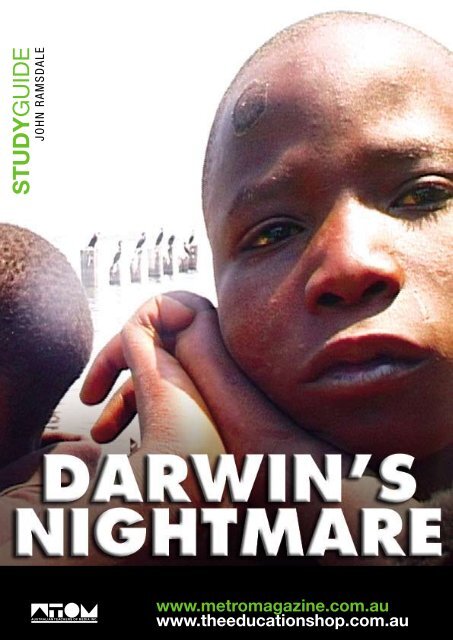
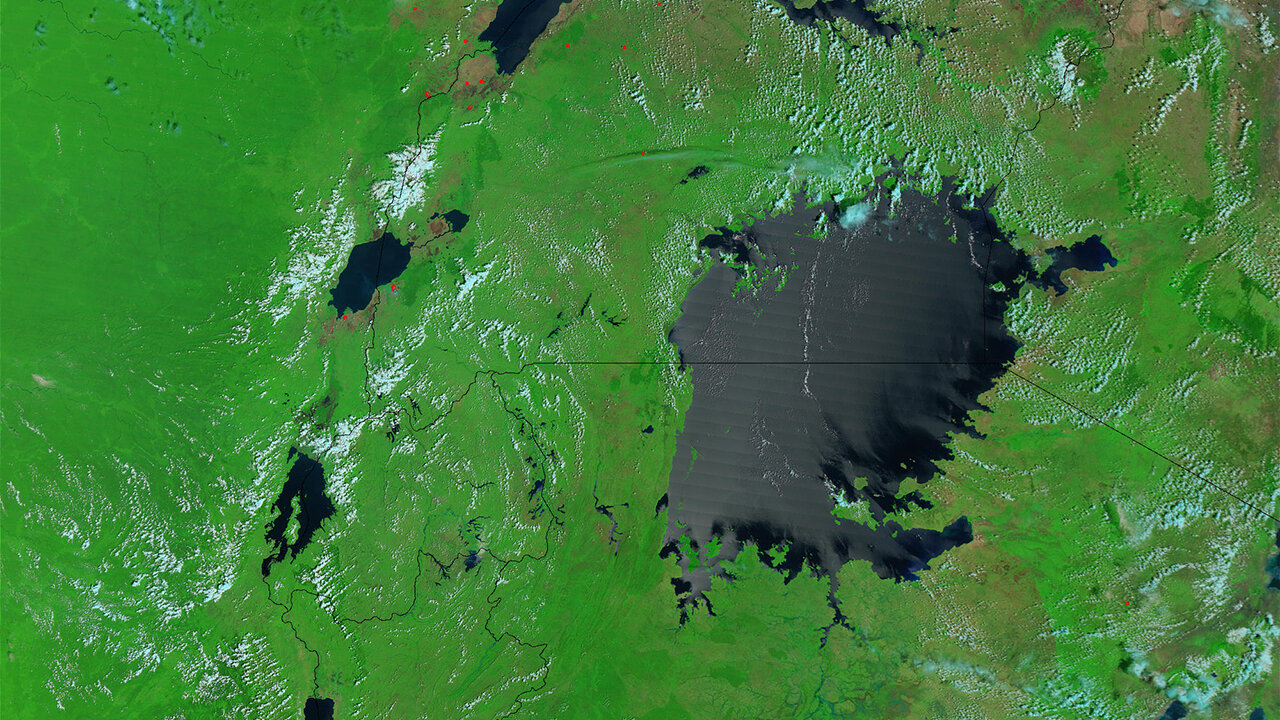
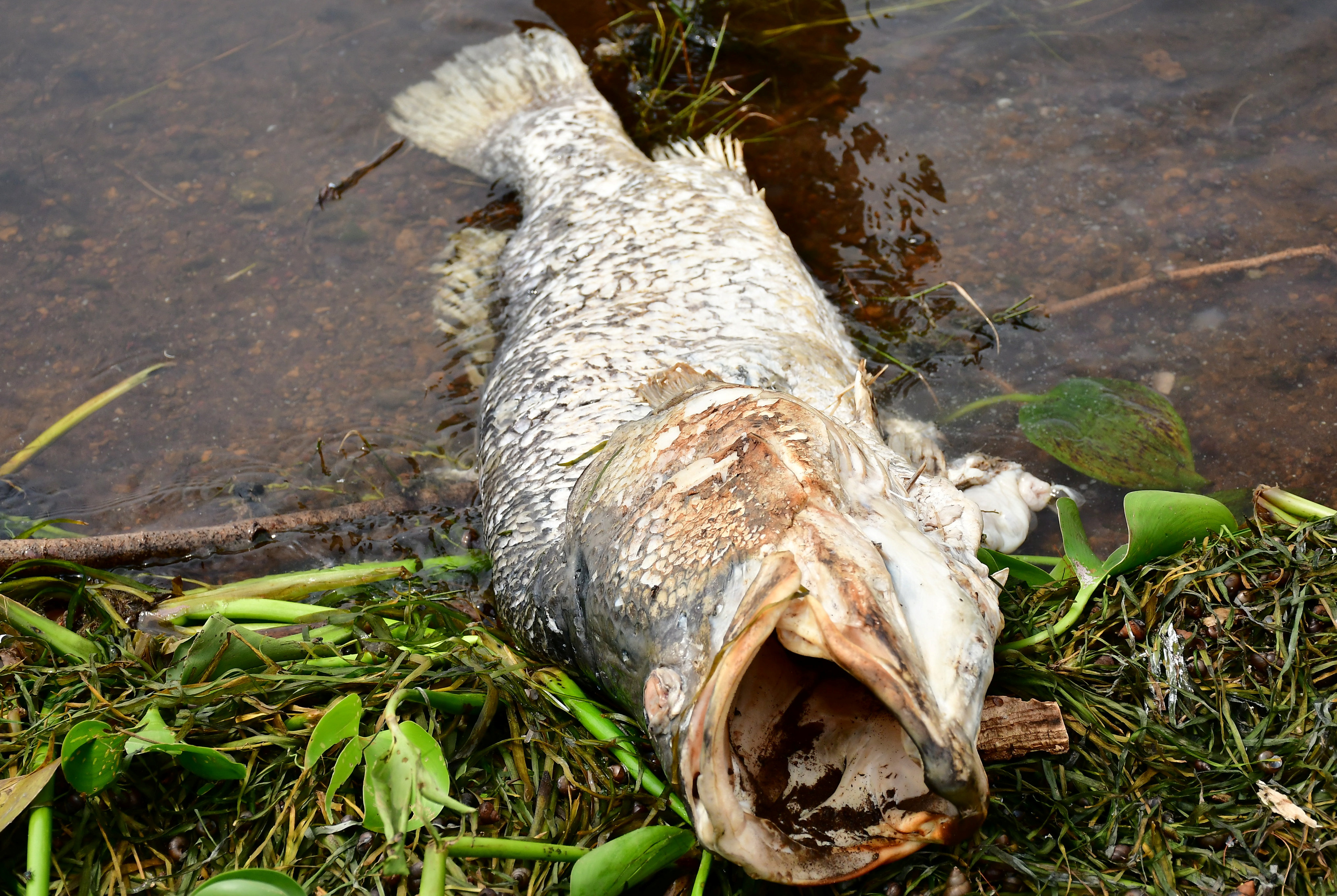
Deemed a “fully realized poetic vision” by David Denby of The New Yorker, Darwin’s Nightmare highlights the need for interdependence not only between human and nonhuman nature, but also among human and nonhuman species. The film chronicles the consequences of a little evolutionary experiment: introducing Nile Perch into Lake Victoria. Fifty years after their introduction, the perch have destroyed 210 species of African Cichlids that once thrived in the lake and controlled the lake’s oxygen levels, and now, according to the IUCN International Climate Congress in Kenya, falling oxygen levels coupled with the perch’s cannibalism may destroy the fishing industry, turning the lake into a “barren sinkhole.”
The perch have destroyed the biotic community of the lake, with one species overwhelming all others, but the perch have also negatively affected the human community. As David Rooney asserts, the film’s director Hubert Sauper “focuses on the ripple effect of a globalized economy in a specific microcosm to weigh the casualties of the New World Order.”
Their destructive behaviors may ultimately destroy the fishing industry, but their introduction into the lake has already changed the industry and the market that sustains it. With huge perch available for export, countries bordering on the lake, especially Tanzania, can no longer rely on the lake for sustenance. Fishermen no longer catch fish for themselves and their families. They catch perch for a factory where they are prepared for shipment to Europe where, according to the film, two million white people eat Victoria fish each day.
Tanzanians are starving, then, because their lake has become a Darwinian nightmare marketplace for Eastern European businessmen and their pilots, who fly cargo planes into Tanzania for their load of perch. They provide nothing for the people living near the lake, but they do contribute even further to their impoverished state, since they bring arms to warring African countries, including Liberia, Zaire, the Congo, and Sudan, leaving more than a million dead.
In return, pilots from Ukraine bring perch back to Europe, while hungry and orphaned Tanzanian children sleep on the streets. The human biotic community has disintegrated here. Tanzanians who once lived interdependently on the lake can no longer feed themselves. Their lake has been decimated, first by the Nile perch, and then by the European colonizers who further disrupt their community.
Highlighting its environmental bent from its opening forward, Darwin’s Nightmare establishes its setting and introduces its perspective differently than does The Cove, contrasting the struggles of impoverished natives with their prosperous Eastern European economic colonizers. The opening song, “Tanzania,” for example, is contrasted with Eastern European music accompanying a plane’s shadow over Lake Victoria, “the source of the Nile” and “the birthplace of civilization,” according to the film. A pan of the town reveals poverty and neglect. Dogs sleep on the sand while fishermen work on their boats. In the streets, one boy runs on crutches, and another cries when a bully punches him. Girls sing to the sound of a synthesizer while a child sleeps on the sidewalk. “They take the fish to the factory,” Marcus, a police officer, explains, and European pilots fly the prepared perch back to their homeland.
With these opening shots, the film’s focus has been established—an interrogation of the dire economic and environmental consequences of introducing perch into the Lake Victoria eco-system.
With a blatantly environmental message, The End of the Line, on the other hand, contrasts a seemingly pristine ocean with its disastrous future. Close-ups of sea life and sky show the passage of time. Coral, neon-colored fish, and crabs are accompanied by violin music. They are revealing a “Marine Protected Area” in the Bahamas, the narrator (Ted Danson) tells us, “protected from the most efficient predator.” The music becomes ominous now, as a shark swims by, but the crescendo rises when the hand of a fisherman brings up a line and nets of fish, trawling that the narrator explains is “like plowing a field seven times per year.” We are the predators, the image tells us, and the title, The End of the Line rolls on the screen.
The Cove draws on the emotional appeal of animal rights arguments in its strong advocacy for the dolphins of Taiji, and Darwin’s Nightmare provides a passionate critique of the human consequences of destroying Lake Victoria’s ecosystem, but both Darwin’s Nightmare and The End of the Line immerse themselves in wise use environmental arguments similar to Aldo Leopold’s land ethic.
Although Darwin’s Nightmare and The End of the Line more logically connect with long-term environmental solutions, however, because The Cove meets its goal to end dolphin slaughter, at least temporarily, and slow its progress, we argue that the film employs the most effective rhetorical strategies, emotionally-appealing strategies grounded in the Animal Liberation Movement’s claims that all animals are equal because, like humans, they feel pain.